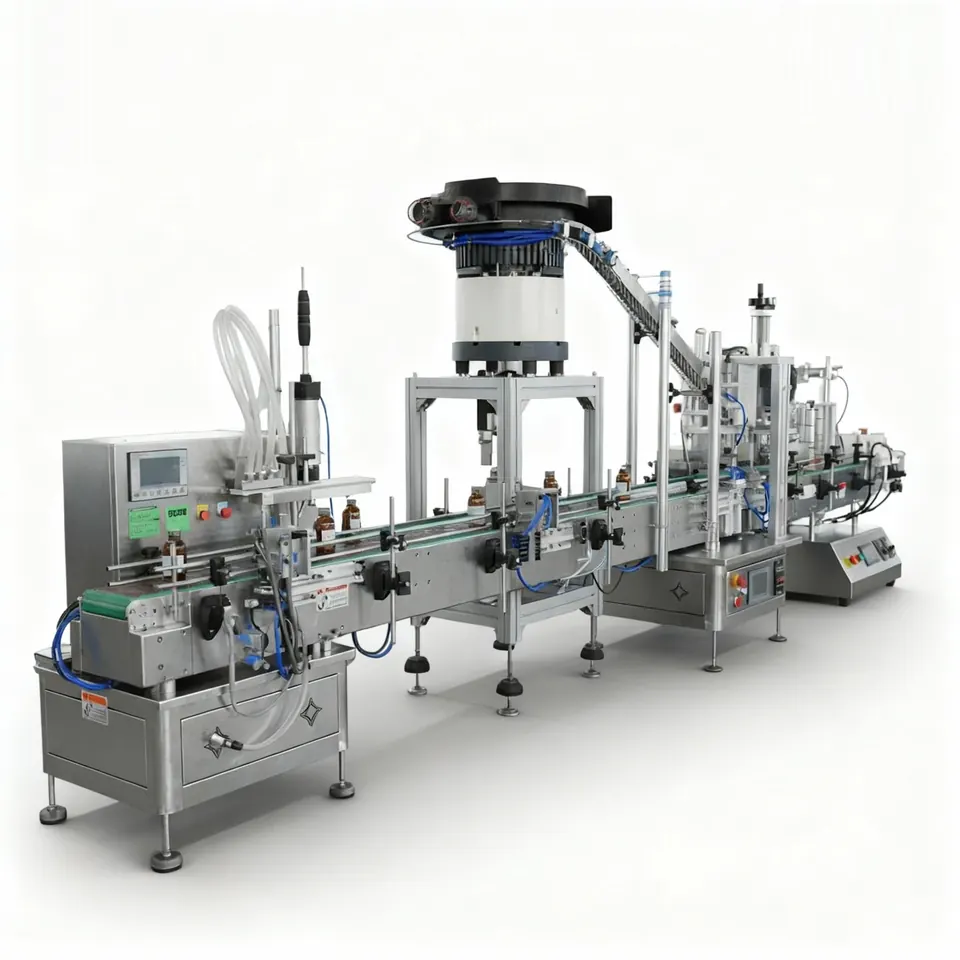
Plan your packaging line around the product, output, space and growth you need
Packaging line solutions

Compact Packaging Lines

Compact lines concentrate the required processes into a smaller footprint without ignoring access, guarding, cleaning or changeovers. They suit operations that need more control than a collection of stand-alone machines.

UK project supportProduct and pack trialsIntegration to handover
Compact packaging machinery series
A coordinated production route

Specify the line as one operating process

Compact lines concentrate the required processes into a smaller footprint without ignoring access, guarding, cleaning or changeovers. They suit operations that need more control than a collection of stand-alone machines.

The engineering brief should describe the required good packs at the end of the line, not only the cycle rate of individual machines. Product behaviour, component quality, replenishment, changeovers, inspection and short stops all affect the sustainable result. The line should therefore be balanced around the real production calendar and a defined operating margin.

Start with evidence

Provide representative product, containers, closures, labels and secondary packaging from the approved range. Include the most difficult combinations, dimensional tolerances and any temperature or storage conditions that change behaviour.

Typical line stages

  1. Compact infeed and container controlDefine the incoming condition, operator activity and transfer requirements before equipment is selected.
  2. Integrated or closely coupled filling and cappingMatch the process technology to representative product and packaging samples across the full approved range.
  3. Space-efficient labelling and codingCoordinate the mechanical and control interfaces so upstream and downstream stages recover predictably.
  4. Accessible discharge, collection or packing areaConfirm inspection, rejection, documentation and handover requirements against measurable acceptance criteria.

What shapes the final specification

These subjects should be resolved with values, samples and named responsibilities. Where uncertainty remains, the proposal should state the assumption and the test or design review that will close it.

Specification point 1

Available footprint and operator access

Record the operating range, difficult extremes and any allowable variation rather than supplying only a nominal value.

Specification point 2

Expected output and manual replenishment tasks

Include controlled samples, drawings or test evidence so the design basis can be verified before manufacture.

Specification point 3

Changeover frequency and format range

State the required result and how it will be checked during factory and site acceptance testing.

Specification point 4

Utilities, guarding and maintenance clearance

Assign the interface owner and document the utilities, access, safety and maintenance implications.

Performance and acceptance

Acceptance criteria should define the tested format, material quantities, operating duration, good output, quality checks, allowable interruptions and action-closeout process. A factory acceptance test demonstrates the line before dispatch; site acceptance confirms installation, utilities, interfaces and agreed production performance in the operating environment.

More output from constrained floor spaceBuilt into the project brief and verified at the agreed handover stage.
Fewer manual transfers between stagesBuilt into the project brief and verified at the agreed handover stage.
A controlled route into automationBuilt into the project brief and verified at the agreed handover stage.
Simpler future expansion planningBuilt into the project brief and verified at the agreed handover stage.

Information to send with an enquiry

  • Product description, safety information and representative samples
  • Container, closure, label and case drawings or physical samples
  • Fill or pack range, target good output, batch size and shift pattern
  • Available layout, access, working heights and utility details
  • Required checks, reject handling, coding and production data
  • Installation window, training, spares and support expectations
Clear project answers

Compact Packaging Lines FAQs

What makes a packaging line compact?

The modules, transfers and controls are arranged to minimise footprint while preserving safe access and process reliability.

Are compact lines fully automatic?

They can be automatic or operator-assisted. The right level depends on output, labour, replenishment and budget.

Can a compact line be expanded?

Yes, when interfaces and floor layout are planned from the outset. Future conveyors, inspection or end-of-line modules can be allowed for.

Compact line planning

Use the available footprint without trapping operation and maintenance

A compact packaging line is successful when it reduces unnecessary travel and transfer length while preserving safe access, stable pack flow, cleaning space and room to remove change parts. The layout should be tested as an operating workplace, not only as a drawing that fits inside the room.

Compact line space schedule

Record the space needed around each function before fixing the final machine arrangement.

Footprint and access review for a compact packaging line
Space zoneQuestions to resolveDesign consequence
Production routeCan product, empty packs, closures, labels and finished packs move without crossing or obstructing one another?May determine a straight, return, L-shaped or cell arrangement and the direction of operator travel.
Operator positionWhere are packs loaded, materials replenished, settings confirmed and quality checks completed?Controls reach distances, work height, visibility and the number of people who can work without interference.
Changeover clearanceCan guides, nozzles, tooling, guards and product-contact parts be removed and stored safely?Sets minimum aisle and door-opening space that is often missing from a footprint-only drawing.
Cleaning accessCan spills, dust, product-contact routes and floor areas be reached without dismantling unrelated equipment?Influences frame design, drainage, cable routing and removable or mobile modules.
Maintenance accessCan panels, drives, sensors, belts, pumps and service items be inspected or replaced?May require pull-out modules, service-side zoning or wider local access even on a compact line.
Future connectionIs there a defined boundary for a later feeder, capper, labeller, inspection unit or end-of-line stage?Protects expansion space, working height, power, controls and transfer provisions.

Compactness should remove waste, not useful operating space

Review each reduction in footprint against the work that must still be completed during a normal shift.

Shorten transfers

Keep stable packs close to the next process, while retaining the spacing and inspection distance the equipment needs.

Share operator zones

Place replenishment and control points so one operator can supervise related tasks without unsafe reaching or blind areas.

Control mobile equipment

Where modules are moved for cleaning or format change, define repeatable docking, service connection and guarding arrangements.

Protect service access

Use the service-side envelope from supplier drawings and practical removal routes, not only the machine frame dimensions.

Evidence to collect during the compact-line review

A scaled layout should be supported by real components and maintenance information.

  • Measured room, columns, doors, drainage, low ceilings, fire routes and fixed services.
  • Largest and least stable packs, plus trays, totes, cases and pallets used for replenishment or removal.
  • Supplier access drawings, guard and panel swing areas, lift-out dimensions and the mass of removable parts where available.
  • Normal operator sequence for loading, inspection, reject removal, cleaning and format change.
  • Storage location for change parts, labels, closures, tools, cleaning equipment and work in progress.
  • A future-state sketch showing the connection points that must remain accessible after the initial installation.
Buyer questions

Compact packaging line questions

Can a compact line still include accumulation?

Yes, where the buffer has a defined purpose and the pack is suitable. The design may use a short controlled buffer, a compact table or another arrangement, but its real usable capacity and recovery behaviour should be checked.

What is commonly missed on a compact layout?

Door and guard movement, part-removal routes, cleaning access, operator replenishment space and finished-pack handling are often omitted when only the machine frames are placed on a plan.

Is a compact line suitable for future automation?

It can be, provided the initial design preserves interface heights, controls capacity, service points and a physical expansion boundary. Future modules should be shown on the layout before the first phase is frozen.

Turn the guidance into a project brief

Use the related pages to document the product, pack, output, layout and acceptance evidence before requesting a detailed proposal.

Your packaging line starts with the right brief

Tell us what you need to pack

Share your product, container or pack, closure, label, target output and available space. We will help you define a practical line route and the next information needed.