Plan your packaging line around the product, output, space and growth you need
Industry packaging lines

Food & Beverage Packaging Lines

Food and beverage projects need a line that respects product flow, hygiene, pack integrity and practical cleaning while maintaining the required saleable output.

Application-led designRepresentative product trialsUK support
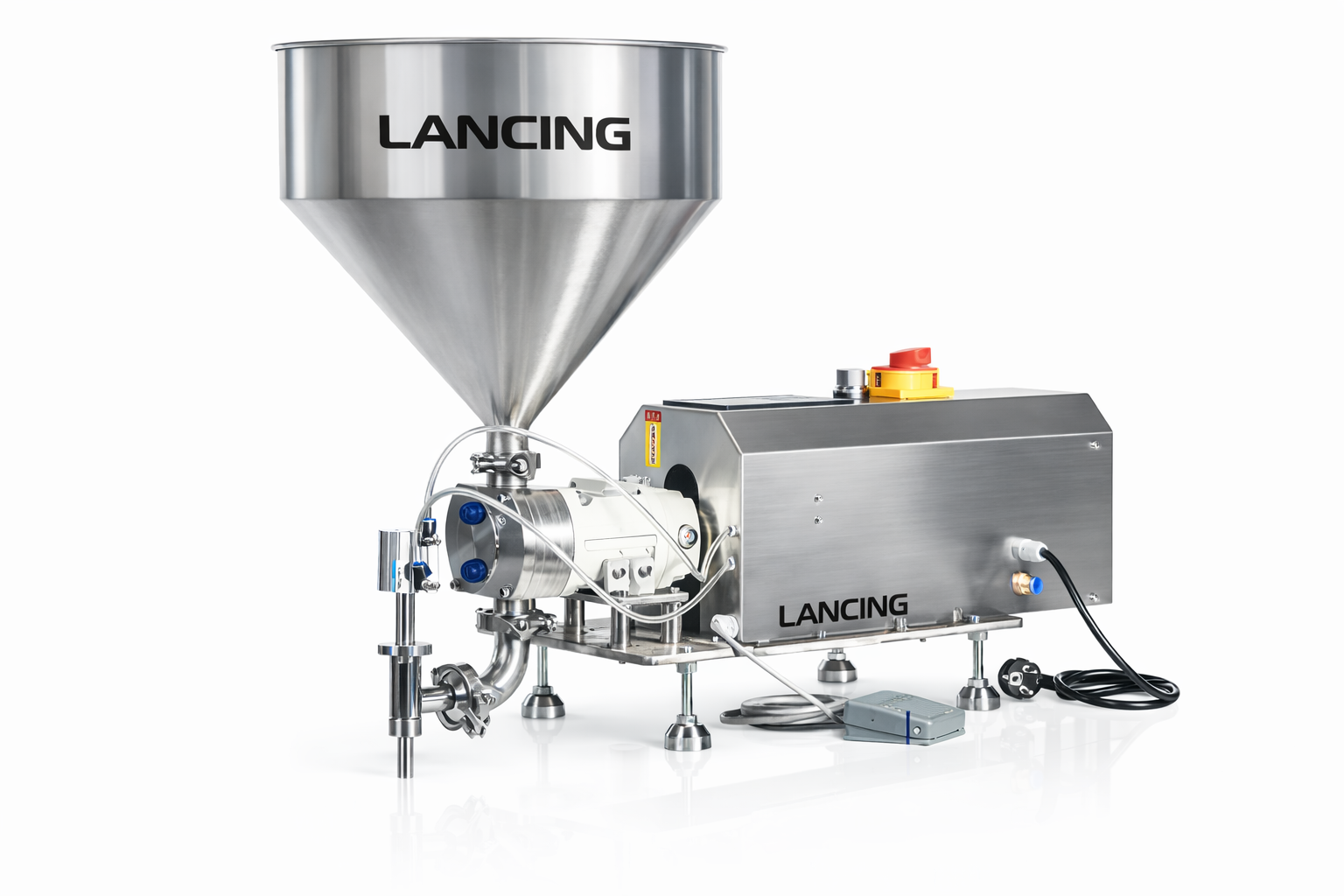
Rotor pump filler for gels, pastes and viscous products
Application scope

Products and pack formats to define

Food and beverage projects need a line that respects product flow, hygiene, pack integrity and practical cleaning while maintaining the required saleable output. The complete approved range should be recorded before final equipment sizing and tooling decisions.

Product and pack

Water, juices, oils and free-flowing liquids

Confirm representative samples, operating conditions and the required production range.

Product and pack

Sauces, dressings, syrups and viscous foods

Confirm representative samples, operating conditions and the required production range.

Product and pack

Powders, seasonings, granules and dry ingredients

Confirm representative samples, operating conditions and the required production range.

Product and pack

Bottles, jars, tubs, pouches and larger containers

Confirm representative samples, operating conditions and the required production range.

Typical process route

Build the line around product behaviour

The most reliable route considers product supply, container control, dosing, closing and presentation as one sequence.

  1. Prepare and control empty containersDefine equipment, transfers, controls and the evidence needed to accept this stage.
  2. Dose product with a method suited to viscosity and particulatesDefine equipment, transfers, controls and the evidence needed to accept this stage.
  3. Apply closures, seals or lids consistentlyDefine equipment, transfers, controls and the evidence needed to accept this stage.
  4. Label, code, inspect and assemble transport packsDefine equipment, transfers, controls and the evidence needed to accept this stage.
Packaging line used to illustrate food & beverage packaging lines
Risk-led specification

Issues to resolve before machine selection

Each risk should be converted into a design requirement, a trial, an operating control or an explicitly accepted limitation. Product and component samples should represent the difficult extremes rather than only a nominal production format.

  • 1
    Foam, stringing, drips or product contamination on the pack

    Assess the likelihood, production effect and design or operating control before the line is ordered.

  • 2
    Allergen, hygiene and cleaning requirements

    Assess the likelihood, production effect and design or operating control before the line is ordered.

  • 3
    Hot-fill or temperature-related container behaviour

    Assess the likelihood, production effect and design or operating control before the line is ordered.

  • 4
    Frequent recipe and format changeovers

    Assess the likelihood, production effect and design or operating control before the line is ordered.

Application brief checklist

Send the following information with the initial enquiry. Early clarity usually shortens the route to a credible line concept and makes quotations easier to compare.

  • Product temperature and viscosity range
  • Ingredients, particulates and cleaning method
  • Container, closure, seal and label samples
  • Required output, shifts and batch sizes
  • Hygiene zoning and utilities
  • Case, tray, film and pallet requirements

Testing and production handover

Agree the factory and site test materials, run duration, quality checks, required good output and treatment of interruptions. Training should cover safe startup, shutdown, replenishment, changeover, cleaning, first-off approval and basic fault response.

Clear project answers

Food & Beverage Packaging Lines FAQs

Can one line handle several food products?

Often, subject to compatible product-contact design, cleaning validation, dosing range and changeover controls.

How are sauces with particulates filled?

The product path, valve and nozzle opening must be sized around the largest particulate, with trials using representative product.

Is food-grade construction automatic?

No. Materials, surface finish, drainability, cleanability and documentation should be specified for the actual duty.

Product and hygiene evidence

Define the food or beverage duty across the complete packaging line

Product behaviour, residue, cleanability, closures, labels, coding and line clearance interact and should be trialled as one controlled system.

Food and beverage projects should define the product and hygiene duty across the complete path, not only the filler. Record product temperature and behaviour, contamination or allergen controls, product-contact and splash zones, cleaning method, closure/label sensitivity to product residue, conveyor cleanability and the evidence required before production release.

Production-intent trials can reveal foam, drips, particulates, container wetting, closure contamination, label adhesion and residue areas. The site’s competent food-safety and quality team should approve the product handling, cleaning and verification method for the actual process.

Food and beverage packaging-line evidence matrix
Decision areaInformation to supplyTrial or design evidence
Product handlingComposition/behaviour, temperature, particulates, foam, hazards and supply condition.Representative fill/process trial and product-recovery observation.
Pack and closureContainer stability, neck/opening, seal/closure, surface, storage and supplier variation.Handling, application and quality challenges at operating extremes.
Cleaning and hygieneContact/splash zones, chemicals, method, disassembly, drains and release standard.Cleanability review, observed residue route and approved site method.
Coding and traceabilityBatch/date/other required information, source data, verification and records.Message-to-pack challenge, reject and reconciliation test.
Changeover and line clearanceProduct/format sequence, clean/dirty parts, labels/codes and first-off approval.Observed controlled change and release evidence.

Use the cleaning and hygienic-design guide, the sample-trial guide and the data and traceability guide to develop the sector-specific project evidence.

Buyer questions

Food and beverage packaging-line planning questions

Why should filled packs be included in handling trials?

Filled weight, centre of gravity, product on the pack surface and temperature can change stability, transfer, capping, labelling and inspection behaviour compared with empty containers.

Should cleaning requirements be defined before equipment selection?

Yes. Product risk, cleaning method, chemicals, access, drainage, disassembly and release evidence can change materials, layout, conveyors and operating time.

How should product changes be handled after a successful trial?

Review the changed composition, supplier, temperature, viscosity, particulates or other relevant characteristic against the approved evidence and repeat focused testing where needed.

Bring product, hygiene and pack evidence into one line review

Share production-intent products and packs, the intended cleaning method and required quality/coding checks. Lancing can define the complete-line trial and integration scope.

Your packaging line starts with the right brief

Tell us what you need to pack

Share your product, container or pack, closure, label, target output and available space. We will help you define a practical line route and the next information needed.